Travel In Provence Logo
Private Tours → Tricastin Black Truffle: On the Trail of the “Black Diamond”
🚗 Driving Tour · 2 hours · Up to 4 people

Tricastin Black Truffle: On the Trail of the “Black Diamond”

250 €
Tricastin Black Truffle: On the Trail of the “Black Diamond”
2 hours | Up to 4 people | 250 €
Book This Tour →

A tour from December to early March, in the Drôme Provençale and the Enclave des Papes

Every winter, as the vines lie dormant and the oaks shed their leaves, Provence reveals its best-kept treasure: Tuber melanosporum, the black truffle of the Tricastin. Join me as I meet those who hunt, sell, and celebrate this delicacy, across two markets with very different atmospheres.

What's Included
The truffle market of Richerenches (Saturdays) or Saint-Paul-Trois-Châteaux (Sundays)
Meeting the producers, brokers and truffle growers
Learning to tell the black truffle from the musky truffle
Not Included
Personal purchases at the market
250 €
Book Now

A Winter of Truffles: Two Markets

Black truffles in a glass bowl on a market stall, with a weighing scale and coins on the table
Sniffed, weighed, and negotiated

Richerenches, Saturdays: The Professionals’ Market

In this village within the Enclave des Papes—a former Templar commandery—the market takes place in a parking lot on the western edge of the village. It unfolds in an almost secretive atmosphere, among brokers, restaurateurs, and producers. Baskets are opened just a crack; truffles are sniffed, weighed, and negotiated in hushed tones. This is the place to understand how the price of a truffle is determined. The season begins with the Ban des Truffes (the official opening of the truffle season), featuring a procession by the truffle brotherhood and a demonstration of truffle hunting.

A large black truffle under a glass cloche, next to a basket of truffles, on a tablecloth printed “Marché aux truffes Saint-Paul-Trois-Châteaux”
At the Saint-Paul-Trois-Châteaux truffle market

Saint-Paul-Trois-Châteaux, Sundays: The Truffle Growers’ Market

On the Place de l’Esplan, in the heart of the former capital of the Tricastin, producers sell directly to the public. The market is more convivial and accessible: you can chat with the person who planted the oak tree, ask any questions you like, and sample ravioles with truffle. The medieval town and its Romanesque cathedral, located just a stone’s throw away, make for a perfect addition to your morning.

Your guide, in a colourful knitted beret, smelling a black truffle in the woods
Your guide, nose first

Melanosporum or brumale: Learning to tell them apart

At a market, two black truffles might look like close relatives. Yet, they are not all equal—neither in aroma nor in price.

Black truffles on a table and on a kitchen scale, in front of an apron printed “35e Omelette aux truffes, Maison de la Truffe Tricastin”

The black truffle of Tricastin (Tuber melanosporum)

Skin
A black outer skin, covered in small, fairly uniform pyramidal warts
Flesh
A flesh that turns purplish-black when mature, laced with fine white veins
Aroma
A deep, complex, and lingering aroma (reminiscent of the forest floor, cocoa, and damp earth)
Harvest
Harvested from mid-November to mid-March, reaching full maturity in the heart of winter
In the kitchen

However, Tuber melanosporum does not tolerate high temperatures well, as its delicate aromas are easily lost when exposed to heat. It is best enjoyed freshly shaved or grated over a salad or an omelette, allowing its full flavour to shine.

The musky truffle (Tuber brumale)

Skin
A skin that is often smoother, with finer, less distinct warts
Flesh
A more grayish or dark-brown flesh, with wider, more widely spaced white veins
Aroma
A more pungent, musky—sometimes earthy—aroma that dissipates quickly
In the kitchen

Although it has a significantly lower gastronomic and commercial value, the Tuber brumale should not be overlooked. Unlike the Tuber melanosporum, it withstands heat quite well and can therefore be cooked, making it particularly suitable for terrines and pâtés.

Meeting Point

Orange, Saint-Paul-Trois-Châteaux or Richerenches

Staying in Orange? Why it is a great base →

Best Season

December to early March (2026–2027 season)

Languages

English & French

Season: December to early March (2026–2027 season)

  • Richerenches: Saturday mornings
  • Saint-Paul-Trois-Châteaux: Sunday mornings
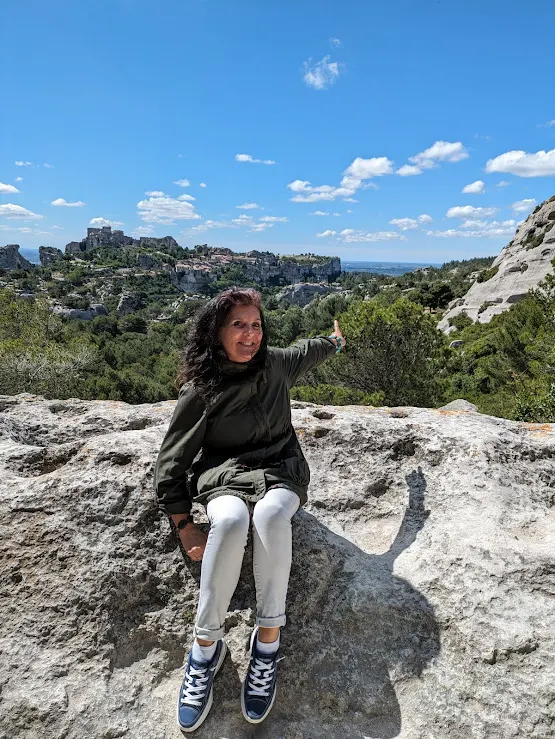
Sophie, your guide, in Les Baux-de-Provence

Sophie, Born in Provence

Sophie was born in Provence, in the black truffle and Grignan-les-Adhémar region. She started Travel In Provence in 2016 as a wine tour guide, then became a licensed history guide. She holds the WSET (2016) and the French Wine Scholar (2021, Wine University of Suze-la-Rousse), and is featured in Rick Steves' Provence & the French Riviera guidebook (2023 edition onward).

Food, wine and history are her passions: her tours mix off-the-beaten-track places with the must-sees that cannot be missed.

More about Sophie →

Good to Know

How long does the tour last?

2 hours.

Is the tour private, and for how many people?

Yes: every tour is private and tailored to your group. This one is for up to 4 people.

Where do we meet?

Orange, Saint-Paul-Trois-Châteaux or Richerenches.

How do we travel?

In Sophie's air-conditioned SUV, a Kia Sportage, with four seats for you, plus Sophie. You can also follow her in your own car.

Can Sophie pick us up anywhere?

Sophie picks you up in Orange, or directly at a place that is part of the tour (for example, your hotel in Arles for the Arles tour). If you are staying elsewhere, she can arrange a private driver (VTC) at your expense. Tour prices do not include transport.

How much walking is there?

The tours are not recommended for young children or for people with reduced mobility: expect stairs and some difficult paths, and the level depends on the tour.

How do we pay?

By bank transfer one month in advance, or on the day.

How much does it cost?

2 hours: 250 €, per group.

Which market do we visit?

Richerenches on Saturday mornings, the professionals’ market; Saint-Paul-Trois-Châteaux on Sunday mornings, the truffle growers’ market.

What is not included in the price?

Personal purchases at the market.

When is the best time to go?

December to early March (2026–2027 season).

Which languages does Sophie speak?

English and French.

How do I book?

Write to Sophie or call her: her email and phone number are on the Prices & Reservation page, with the price of every tour.

Ready to Experience Tricastin Black Truffle: On the Trail of the “Black Diamond”?

Every tour is private and tailored to your group.

Get in Touch with Sophie →
← Back to all tours

Your cookie choices

With your consent, this site measures its audience with Google Analytics, shows its YouTube videos and plays Sophie's Instagram reels, all of which set cookies. Nothing is loaded before you choose, and you can change your mind at any time from “Manage cookies” at the bottom of the page. Read our cookie policy

Choose